
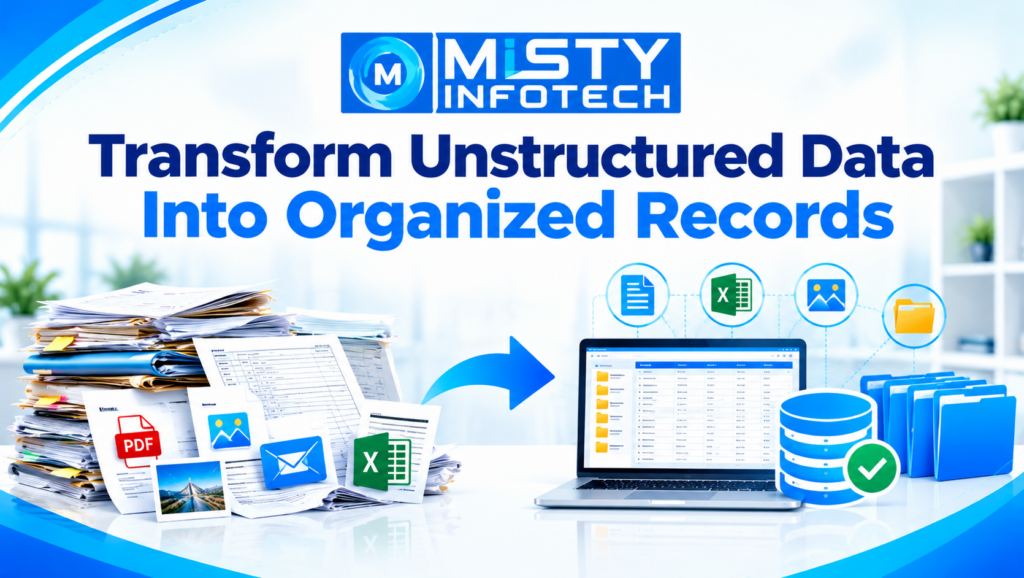
Transform Unstructured Data Into Organized Records
Businesses collect information from numerous sources, including scanned documents, emails, invoices, application forms, spreadsheets, customer records, and digital reports. However, when this information is scattered across different files or stored in inconsistent formats, it can be difficult to manage and use effectively.
Transforming unstructured data into organized records helps businesses make information easier to search, review, update, and process. With suitable data entry procedures, document processing tools, and verification methods, organizations can turn scattered information into structured digital records that support daily operations.
In this blog, we explore how businesses can organize unstructured information, improve data quality, and develop a more effective approach to information management.
What Is Unstructured Data?
Unstructured data is information that does not follow a consistent, predefined format. It may include text, images, scanned pages, emails, PDFs, and other documents that are not organized into standard database fields.
For example, a business might store customer details in email messages, scanned application forms, and separate spreadsheets. Finding a particular customer’s information can become difficult when these records use different formats.
Organizing this information involves identifying relevant details, extracting the required data, applying consistent formats, and storing the results in a suitable system.
Why Businesses Need Organized Data
Well-organized records can make everyday business activities more manageable. When information is stored consistently, employees can spend less time searching through files and more time using the information for relevant tasks.
Key benefits include:
Easier information retrieval: Organized records help authorized employees locate required details more quickly.
Improved consistency: Standardized formats reduce unnecessary variations across records.
Better data quality: Verification procedures help identify missing, duplicate, or incorrect entries.
Simplified reporting: Structured information is easier to filter, sort, and analyze.
More efficient workflows: Consistent records can reduce repeated data handling and administrative effort.
Better record maintenance: Standardized processes make it easier to update information over time.
The value of organized data depends on the accuracy of the source information and the effectiveness of the procedures used to process it.
7 Steps to Transform Unstructured Data Into Organized Records
1. Identify and Collect Information Sources
The first step is to identify where business information is stored.
Sources may include scanned documents, PDF files, emails, printed forms, images, spreadsheets, and existing databases.
Businesses should determine which information is relevant to the project, who is authorized to access it, and what the final records need to contain.
A clear scope helps prevent unnecessary processing and reduces confusion during the project.
2. Extract Relevant Information
Once the source documents have been reviewed, the required information can be extracted.
Depending on the format, this may involve manual data entry, document conversion, text extraction, or Optical Character Recognition (OCR).
For example, customer names, invoice numbers, dates, and transaction details may be extracted from scanned documents and transferred into a structured spreadsheet.
OCR can speed up the extraction of printed text, but its output should be checked for errors, particularly when documents are unclear or contain complex layouts.
3. Create a Standard Data Structure
Before entering large amounts of information, businesses should decide how the records will be organized.
A spreadsheet or database may use fields such as:
Record ID
Customer or company name
Contact details
Document date
Reference number
Category
Status
Remarks
The structure should reflect the purpose of the records. Not every project requires the same fields, and sensitive information should only be collected when necessary and authorized.
4. Standardize Data Formats
Unstructured information may contain inconsistent spelling, date formats, abbreviations, and naming conventions.
Standardization helps bring these variations into a consistent format.
For example, a business may establish one approved date format, consistent category names, and a standard method for recording reference numbers.
Standardization rules should be documented so employees follow the same procedures throughout the project.
5. Identify Duplicates and Incomplete Records
Duplicate entries and missing fields can reduce the usefulness of a database.
Businesses can use unique identifiers, matching rules, and manual reviews to identify records that may require correction.
However, similar records are not always duplicates. Before merging or deleting entries, employees should confirm that the records represent the same entity and follow the appropriate approval process.
Incomplete information should be flagged rather than guessed or filled with unsupported details.
6. Verify Data Accuracy
Verification helps ensure that the organized records accurately reflect the source documents.
Quality checks may include comparing extracted values against original files, checking required fields, reviewing unusual entries, and sampling completed records.
Particular attention should be given to names, dates, financial figures, identification numbers, and other critical information.
Businesses should maintain clear correction procedures and track recurring errors so that the underlying process can be improved.
7. Store and Maintain Organized Records
After processing and verification, the information should be stored in a suitable system.
Depending on business needs, the final output may be a spreadsheet, database, document management system, or another structured format.
Businesses should establish access permissions, backup procedures, file naming conventions, retention periods, and regular update schedules.
Maintaining organized records is an ongoing activity rather than a one-time conversion task.
Common Services Used to Organize Business Data
Different projects require different data-processing methods.
Data Entry Services
Data entry involves transferring information from documents, forms, images, and other sources into digital files or business systems.
It may include customer data entry, product information updates, form processing, and spreadsheet maintenance.
Document Conversion Services
Document conversion transforms information from one format into another.
Common examples include PDF to Word conversion, PDF to Excel conversion, JPG to DOC conversion, and scanned document digitization.
Converted files should be checked for missing content, incorrect values, and formatting issues.
Data Cleaning and Standardization
Data cleaning helps identify and correct problems such as inconsistent formatting, duplicate records, and invalid entries.
Standardization ensures that similar information follows consistent rules, making records easier to maintain and process.
Database Updating
Database updating involves adding new information, correcting existing records, and maintaining consistent data fields.
Businesses should define who can make changes and how updates are reviewed, especially when records are used for important operational decisions.
Document Indexing and Categorization
Indexing assigns identifiers or searchable attributes to documents, while categorization groups information according to defined criteria.
These methods help businesses locate documents and connect them with relevant records.
Industries That Benefit From Structured Data
Retail and E-Commerce
Retailers can organize product descriptions, supplier records, inventory information, and customer details into consistent formats.
Healthcare and Insurance
Healthcare and insurance organizations may process forms, administrative documents, and policy records. These activities require appropriate confidentiality controls and compliance with applicable data-protection requirements.
Education
Schools and educational institutions can organize student information, admission forms, certificates, and administrative records.
Finance and Accounting
Financial teams may structure invoice details, receipts, transaction records, and other documents. Figures and financial information should be carefully verified before use.
Real Estate
Property listings, customer records, application forms, and related documents can be organized for easier retrieval and maintenance.
Logistics and Manufacturing
Shipment records, inventory information, supplier details, and operational reports can be converted into structured records that support routine business processes.
Best Practices for Effective Data Organization
Businesses can improve their data management processes by following these practices:
Define clear objectives: Determine how the organized data will be used.
Use consistent templates: Establish standard fields and formatting rules.
Keep source references: Maintain links or identifiers that allow records to be checked against their original documents.
Apply quality controls: Verify critical fields and correct errors before delivery.
Protect sensitive information: Use appropriate access restrictions and secure file-handling procedures.
Document processing rules: Make sure employees understand how information should be entered, categorized, and updated.
Review records regularly: Identify outdated, incomplete, or inconsistent information.
Maintain backups: Protect important digital records against accidental loss.
These practices can help businesses maintain more dependable records as their information requirements grow.
Data Entry and BPO Support With Misty Infotech
Misty Infotech operates in the data entry, BPO, and data-processing business area. Businesses considering data organization or document processing services should confirm their project requirements, the provider’s capabilities, quality-control procedures, data-security arrangements, and commercial terms.
Misty Infotech also offers a Business Franchise Opportunity for entrepreneurs, business owners, and investors interested in data entry, BPO, data processing, and related business operations.
Depending on the approved business model, franchise partners may receive project-related guidance, technical assistance, operational support, and business process guidance. Interested parties should confirm the approved scope and terms before making a business commitment.
Important Business Disclaimer
This is a business franchise opportunity for entrepreneurs, business owners, and investors. It is not a job, work-from-home opportunity, freelance work, internship, or employment offer.
Conclusion
Transforming unstructured data into organized records helps businesses make information easier to search, maintain, verify, and use.
By identifying information sources, extracting relevant details, standardizing formats, checking accuracy, and maintaining secure digital records, organizations can develop a more reliable approach to data management.
The most effective process combines suitable technology with clear instructions, quality checks, and ongoing maintenance. With the right approach, scattered documents can become structured business information that supports everyday operations and informed decision-making.
So, we are also on Facebook
Go back to home page: www.mistyinfotech.com
If you want to Direct Data Entry Projects with Company with Us Please go here: Direct Data Entry Projects with Company