
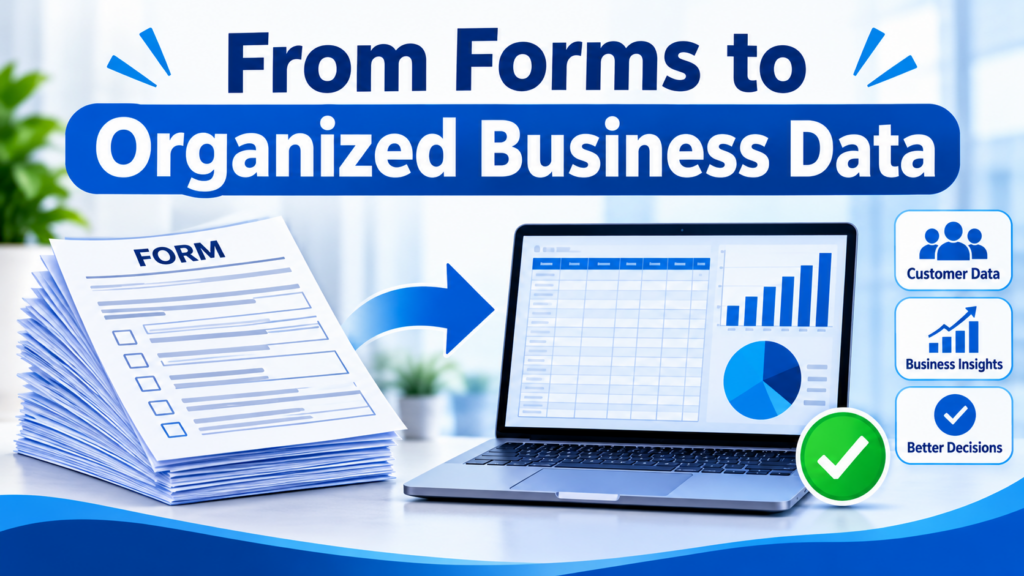
From Forms to Organized Business Data
Businesses collect information through forms every day. Customer registration forms, application forms, enquiry records, feedback forms, insurance documents, and other business records contain details that are important for daily operations.
However, collecting information is only the first step. To make it useful, businesses need to convert form entries into structured, searchable, and properly organized records.
When forms are stored in different formats or handled without a consistent process, information can become difficult to retrieve and maintain. Duplicate entries, missing details, and inconsistent formatting may also affect record quality.
Converting forms into organized business data helps companies manage information more efficiently and create a reliable foundation for their operations.
What Does It Mean to Convert Forms Into Organized Business Data?
This process involves extracting information from physical or digital forms, entering it into a structured format, checking the details, and organizing the resulting records.
For example, a business may receive hundreds of customer registration forms. Instead of keeping all the information in separate documents, the details can be transferred into a spreadsheet or database with consistent fields such as customer name, contact information, registration date, and service category.
The organized records can then be searched, updated, reviewed, and used for relevant business activities.
Why Is Organized Form Data Important?
Properly organized information helps businesses maintain control over their records and reduces the effort required to locate important details.
1. Easier Information Retrieval
When information is stored in structured spreadsheets or databases, authorized employees can search for specific records more easily. This reduces the need to review individual forms repeatedly.
2. Better Record Accuracy
A consistent data entry process and appropriate verification checks can help identify missing information, duplicate entries, and formatting errors.
3. Improved Customer Record Management
Organized customer information helps businesses maintain records of registrations, enquiries, service requests, and other relevant interactions.
4. Reduced Administrative Work
Converting multiple forms into structured records can reduce repetitive manual handling and help employees focus on their primary responsibilities.
5. Better Reporting and Planning
Structured information can be reviewed and summarized to prepare reports. Depending on the quality and relevance of the data, these reports may support business planning and operational reviews.
Types of Forms That Can Be Converted Into Business Data
Businesses use different forms depending on their industry and operational requirements. Common examples include:
Customer Registration Forms
These forms contain customer details, contact information, registration dates, and other relevant fields. Converting them into organized records helps maintain a structured customer database.
Enquiry Forms
Businesses receive enquiries through websites, advertisements, and other communication channels. Organizing enquiry information can help teams review and manage incoming requests.
Application Forms
Application forms may be used by companies, educational institutions, service providers, and other organizations. The information can be transferred into spreadsheets or databases for further processing.
Insurance Forms
Insurance-related documents may contain policy details, applicant information, and other administrative records. Such information should be handled carefully and according to applicable confidentiality and data-protection requirements.
Survey and Feedback Forms
Survey responses can be converted into structured datasets, making them easier to categorize and review.
Employee and Vendor Forms
Businesses may use forms to maintain authorized employee, supplier, and vendor information. Organized records can support internal administration.
PDF and Scanned Forms
Information from scanned documents and PDF forms may need to be extracted and entered into editable spreadsheets or databases. The quality of the original document can affect the accuracy of extraction, so verification is important.
The Process of Converting Forms Into Organized Data
A systematic workflow helps maintain consistency when processing large numbers of forms.
Collect the source forms: Gather the physical or digital forms from approved sources.
Understand the required fields: Identify the information that needs to be extracted and the expected output format.
Extract the information: Read the source documents and identify the relevant details.
Enter the data: Transfer the information into the required spreadsheet, database, or business system.
Standardize the records: Apply consistent formatting, field names, and categories.
Verify the entries: Review records for missing fields, possible duplication, and incorrect values.
Organize and deliver: Arrange the completed information in the agreed format for business use.
The exact workflow depends on the form type, document quality, processing volume, and project requirements.
Common Challenges in Form-to-Data Conversion
Converting forms into structured business records may involve several challenges.
Poor Document Quality: Blurred scans, faded printing, and handwritten entries can make information difficult to read.
Incomplete Information: Some forms may contain blank fields or missing details. Such entries should be handled according to the project’s instructions rather than filled with assumptions.
Duplicate Records: The same customer or business information may appear in multiple forms. Suitable checks can help identify potential duplicates.
Inconsistent Formats: Dates, phone numbers, addresses, and other fields may be recorded differently. Standardization helps make the information easier to manage.
Large Processing Volumes: Processing thousands of forms can require a planned workflow, sufficient resources, and regular quality checks.
How Professional Data Processing Support Can Help
Businesses with large volumes of forms may consider professional data entry and processing support.
A suitable service provider can assist with tasks such as form data entry, PDF form processing, scanned document conversion, spreadsheet preparation, database updating, data verification, and record organization.
Outsourcing these activities may help businesses manage repetitive information-processing work without placing additional pressure on their internal teams.
Before selecting a provider, businesses should review its experience, quality-control procedures, confidentiality practices, ability to follow instructions, and delivery arrangements.
What Businesses Should Consider Before Starting a Form Processing Project
A clearly defined project scope helps avoid confusion during processing. Businesses should decide which fields need to be captured, which documents can be used as sources, how incomplete entries should be treated, and what output format is required.
They should also establish quality standards, verification requirements, access permissions, data retention practices, and delivery timelines.
For projects involving personal, financial, medical, or other sensitive information, appropriate safeguards and applicable legal requirements must be considered.
Form Processing and Data Entry Support by Misty Infotech
Misty Infotech provides BPO, data entry, data processing, document conversion, and back-office support solutions for businesses.
Its information-related services can support requirements involving customer forms, application records, PDF documents, scanned forms, spreadsheet preparation, and database updating.
Businesses can discuss their project requirements, including document formats, processing volumes, information fields, verification procedures, and expected output, with the Misty Infotech team.
Entrepreneurs, business owners, and investors interested in the BPO and business-services sector can also explore the Misty Infotech business franchise opportunity. The proposed business model, eligibility, responsibilities, and commercial terms should be discussed before proceeding.
Conclusion
Forms contain information that businesses need to manage, review, and use in their daily operations. Converting these forms into organized business data makes records easier to access, maintain, and process.
With a structured workflow, consistent data entry, and suitable quality checks, businesses can improve their information management practices and reduce the effort involved in handling large volumes of documents.
From individual forms to organized records, better data management supports better business operations.
Important: This is a business franchise opportunity for entrepreneurs, business owners, and investors. It is not a job, work-from-home opportunity, freelance work, internship, or employment offer

So, we are also on Facebook
Go back to home page: www.mistyinfotech.com
If you want to Direct Data Entry Projects with Company with Us Please go here: Direct Data Entry Projects with Company