
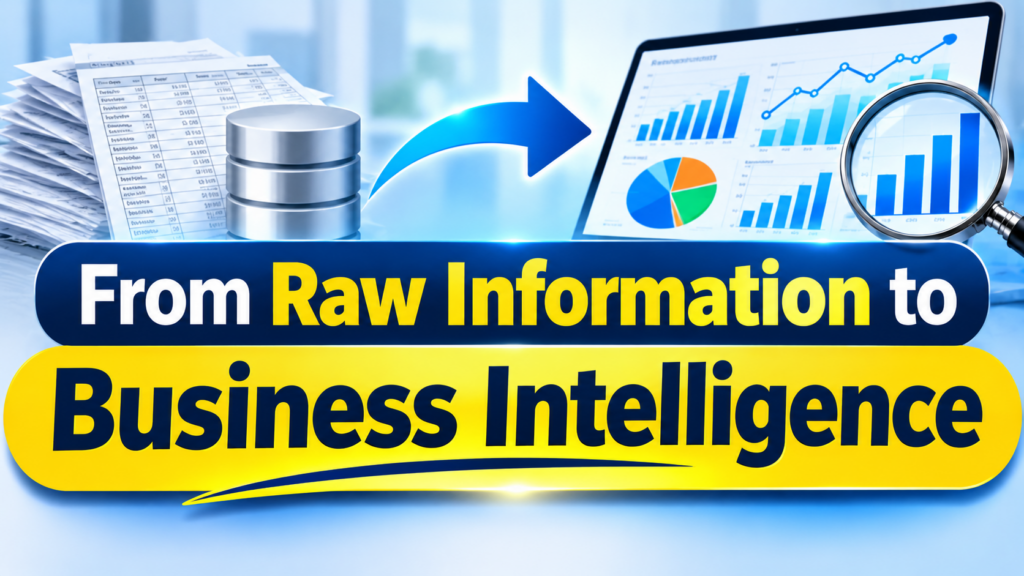
From Raw Information to Business Intelligence
Every business generates information through its daily activities. Customer records, sales transactions, invoices, website enquiries, product details, and operational reports all contribute to a growing collection of business data.
However, raw information alone does not automatically help a company make better decisions. It needs to be collected, organized, checked, and analyzed before it can provide meaningful insights.
Transforming raw information into business intelligence helps organizations understand their operations, identify patterns, and make more informed business decisions.
What Is Business Intelligence?
Business intelligence (BI) refers to the processes and technologies used to collect, organize, analyze, and present business information. It helps organizations understand what is happening within their operations and identify areas that may require attention.
Business intelligence can involve spreadsheets, databases, reporting systems, dashboards, data visualization tools, and analytical software.
For example, a business may have thousands of sales records. When these records are organized and analyzed, the company can review sales performance, compare product categories, identify seasonal patterns, and understand changes in customer demand.
The value comes not only from collecting information but also from making it useful.
Understanding the Journey From Raw Information to Business Intelligence
Converting raw information into useful business insights generally involves several stages.
1. Data Collection
The first step is collecting information from relevant sources. Depending on the business, these sources may include customer management systems, spreadsheets, sales records, websites, invoices, forms, and operational databases.
The objective is to gather information that supports a clearly defined business requirement.
2. Data Entry and Processing
Collected information may exist in different formats, such as scanned documents, printed records, spreadsheets, or digital forms.
Data entry and processing help transfer this information into structured formats that can be stored, searched, and reviewed more easily.
3. Data Cleaning and Verification
Raw information may contain duplicate entries, missing fields, spelling errors, inconsistent formats, or outdated details.
Data cleaning involves identifying and correcting such issues wherever possible. Verification helps check whether important information is complete and consistent with the available source records.
This stage is important because poor-quality information can affect the reliability of later analysis.
4. Data Organization
Once the information has been reviewed, it can be arranged into suitable categories, tables, databases, or spreadsheets.
Consistent field names, formats, and classifications make information easier to understand and retrieve.
5. Data Analysis
Data analysis involves examining organized information to identify patterns, comparisons, relationships, and changes.
Businesses may review sales performance, customer enquiries, product demand, operational costs, or other relevant indicators according to their objectives.
6. Reporting and Business Intelligence
The final stage involves presenting findings in a useful format. Reports, dashboards, charts, and summaries can help management teams understand the information and consider appropriate business actions.
The quality of the final insights depends on the accuracy of the source data, the research methodology, and the suitability of the analysis.
Why Businesses Need to Transform Raw Data Into Useful Insights
Businesses collect information every day, but unorganized records can make it difficult to identify what matters.
Transforming raw information into structured business intelligence can support several important activities.
Better Decision-Making: Organized information helps management teams evaluate business conditions and make decisions based on relevant evidence rather than assumptions alone.
Improved Operational Visibility: Reports can help businesses understand activities such as sales, customer enquiries, order processing, and administrative performance.
Customer Understanding: Organized customer information can help businesses review preferences, interactions, and service requirements while following applicable privacy rules.
Identification of Business Trends: Reviewing historical records may reveal patterns, seasonal changes, and variations in demand.
Improved Information Management: Structured records make information easier to search, compare, update, and maintain.
More Effective Planning: Reliable reports can provide useful background for budgeting, resource allocation, marketing, and business expansion decisions.
Common Challenges in Managing Business Information
Many organizations face difficulties when handling large amounts of information. These challenges can affect both the quality of records and the usefulness of business reports.
Common issues include duplicate records, incomplete information, inconsistent data formats, manual entry errors, disconnected databases, outdated information, and difficulty retrieving records.
Another challenge is collecting information from different departments or systems that use different formats. Without standard processes, combining these records can become complicated.
Businesses can address these issues by defining clear data-handling procedures, using consistent formats, conducting regular quality checks, and selecting appropriate information management tools.
The Role of Data Entry and Data Processing
Data entry and data processing form an important part of the journey from raw information to business intelligence.
Before information can be analyzed effectively, it must be available in a suitable and consistent format. Professional data support can help businesses manage activities such as:
Online and offline data entry
Spreadsheet preparation and updating
Document conversion and data extraction
Database updating and record management
Form and document processing
Data verification and quality checking
Information classification and organization
These services can support businesses that handle large volumes of routine information. The exact scope should be defined according to the project’s requirements, source documents, data format, and verification needs.
How to Build a Better Business Intelligence Process
A practical business intelligence process begins with a clear objective and continues through consistent information management.
Set a clear objective: Identify what the business wants to understand or measure.
Identify information sources: Determine where the required records and information are available.
Standardize data formats: Use consistent fields, categories, and naming conventions.
Check data quality: Review records for missing information, duplication, and inconsistencies.
Select suitable tools: Use spreadsheets, databases, reporting software, or dashboards based on business requirements.
Prepare meaningful reports: Present relevant findings in a format that management can understand.
Review information regularly: Update records and reporting methods as business requirements change.
Businesses should also establish suitable access controls and data security practices, particularly when handling confidential or personal information.
How Outsourcing Can Support Data Management
Managing information internally can require time, trained staff, and suitable systems. When routine data-related tasks become difficult to manage, outsourcing may be an option worth evaluating.
A suitable BPO service provider can support defined activities such as data entry, data processing, document conversion, and back-office information management.
Outsourcing can help businesses manage repetitive workloads and allow internal teams to focus on analysis, customer relationships, planning, and other core responsibilities.
Before selecting a provider, businesses should review its experience, project workflow, quality-control process, confidentiality practices, delivery timelines, and commercial terms.
Data and BPO Support Solutions by Misty Infotech
Misty Infotech provides BPO, data entry, data processing, document conversion, and back-office support solutions for businesses.
These services can help organizations manage information-related activities through structured workflows based on their project requirements. Businesses can discuss their data formats, processing needs, expected output, verification requirements, and project scope with the Misty Infotech team.
Entrepreneurs, business owners, and investors interested in the BPO and business-services sector can also explore the Misty Infotech business franchise opportunity. The proposed business model, eligibility, responsibilities, and commercial terms should be discussed before proceeding.
Conclusion
Raw information becomes valuable when it is organized, verified, and used effectively. By developing a structured approach to data collection, processing, analysis, and reporting, businesses can create a stronger foundation for informed decision-making.
Business intelligence is not simply about collecting more data. It is about understanding which information matters and presenting it in a way that supports business objectives.
From raw information to meaningful insights, better data management can support smarter business operations.
Important: This is a business franchise opportunity for entrepreneurs, business owners, and investors. It is not a job, work-from-home opportunity, freelance work, internship, or employment offer.
So, we are also on Facebook
Go back to home page: www.mistyinfotech.com
If you want to Direct Data Entry Projects with Company with Us Please go here: Direct Data Entry Projects with Company