
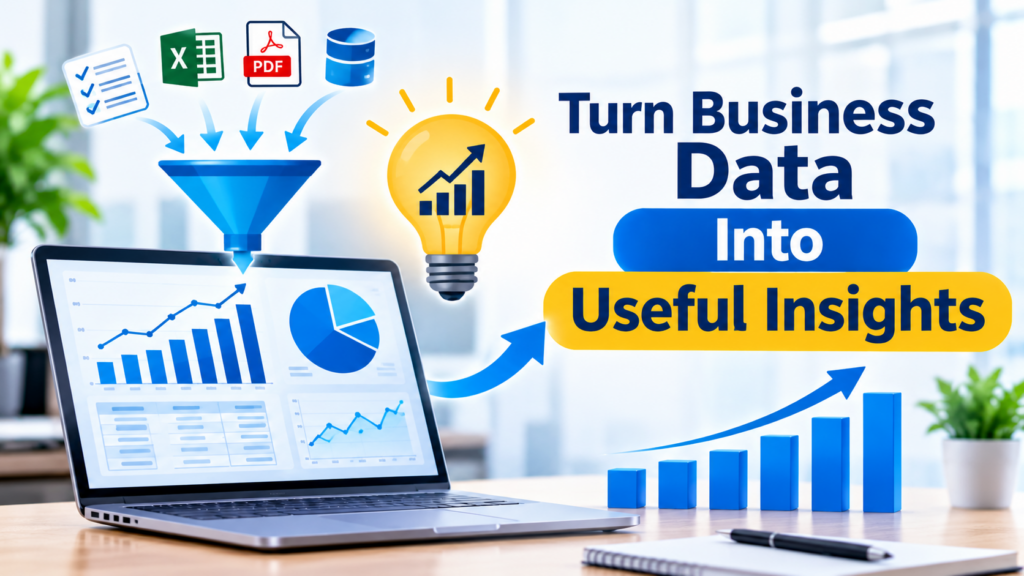
Turn Business Data Into Useful Insights
Businesses collect data every day—from customer records and sales reports to website activity, forms, transactions, surveys, and operational records. But simply having a large amount of data does not automatically help a business grow.
The real value comes from turning raw business data into useful insights that support better decisions, improve processes, identify opportunities, and reveal areas that need attention.
With the right data processing, organization, analysis, and reporting approach, businesses can move from simply storing information to actually using it as a business resource.
What Does It Mean to Turn Business Data Into Insights?
Raw business data often exists in different formats and systems. It may include spreadsheets, forms, PDFs, customer databases, transaction records, survey responses, website information, and internal reports.
On its own, this information may be difficult to interpret.
Turning business data into insights means:
Collecting → Cleaning → Organizing → Analyzing → Interpreting → Applying
This process helps businesses understand what their data is telling them and how that information can support practical business decisions.
Why Raw Data Is Not Enough
A business may have thousands of customer records but still struggle to understand its customers.
Similarly, a company may have years of sales data but not know:
- Which products are performing best
- Which customer segments generate more business
- Where sales are declining
- Which locations are showing growth
- Which processes are creating delays
- Where operational costs can be reduced
- What customer trends are developing
The problem is often not a lack of data. It is a lack of organized and meaningful information.
How Business Data Becomes Useful
1. Data Collection
The first step is gathering information from relevant business sources.
Depending on the business, this may include:
- Customer information
- Sales records
- Lead data
- Transaction records
- Online forms
- Survey responses
- Product information
- Website data
- Market research
- Operational records
- Business reports
Accurate collection creates a stronger foundation for later analysis.
2. Data Cleaning
Raw data can contain duplicate records, incomplete fields, incorrect entries, inconsistent formats, or outdated information.
Data cleaning helps identify and correct these issues before analysis.
For example, the same customer may appear multiple times under slightly different names. Cleaning and standardization can help create a more reliable dataset.
3. Data Organization
Once data has been cleaned, it needs to be organized into a structured format.
Information can be categorized according to factors such as:
- Customer type
- Location
- Product
- Date
- Sales value
- Business activity
- Lead source
- Service category
Organized data is much easier to search, compare, analyze, and report.
4. Data Analysis
Analysis is where businesses begin discovering patterns and relationships within their information.
Businesses can examine areas such as sales performance, customer behavior, operational activity, lead conversion, service demand, and market trends.
The objective is not simply to create numbers or reports. It is to understand what those numbers mean.
5. Finding Patterns and Trends
Useful insights often appear through comparisons over time.
For example, data may reveal that:
- Demand increases during certain periods
- A particular customer segment is more active
- Some products consistently perform better
- Certain locations generate more enquiries
- Customer complaints are concentrated around a specific process
- Some leads are more likely to convert than others
These patterns can help businesses identify opportunities and potential problems earlier.
6. Turning Findings Into Action
The final step is applying the insight to business decisions.
For example, if customer data shows strong demand for a particular service, a company may consider expanding that service.
If operational data identifies repeated delays in one process, management can investigate and improve that workflow.
This is where data becomes a practical business asset.
Types of Business Insights Companies Can Discover
Different datasets can produce different types of insights.
Customer Insights
Customer data can help businesses understand preferences, purchasing patterns, locations, service requirements, and engagement behavior.
Sales Insights
Sales data can reveal product performance, sales trends, high-performing regions, customer segments, and changes in demand.
Operational Insights
Operational information can help identify process delays, repetitive tasks, data-quality issues, workload patterns, and areas where efficiency can be improved.
Market Insights
Market and competitor data can help businesses understand changing demand, industry developments, competitor activity, and potential market opportunities.
Financial Insights
Organized financial and transaction data can support analysis of revenue patterns, expenses, transaction volumes, and other measurable business activities.
Benefits of Turning Business Data Into Useful Insights
Better Decision-Making
Decision-makers can use organized evidence instead of relying entirely on assumptions or incomplete information.
Improved Business Planning
Historical and current data can help businesses identify patterns that may be useful when planning future activities.
Better Customer Understanding
Customer information can reveal what different customer groups need and how their behavior changes over time.
Improved Operational Efficiency
Data analysis can expose bottlenecks, repetitive work, and areas where processes may be improved.
Faster Identification of Problems
Regular data analysis can make unusual changes and performance issues easier to identify.
Identification of New Opportunities
Patterns in customer, sales, and market data can highlight potential opportunities that may otherwise remain unnoticed.
The Role of Professional Data Processing Support
Not every business has the internal resources required to collect, clean, organize, and process large volumes of information.
Professional data processing and business support services can help companies manage these activities more systematically.
Depending on business requirements, support may include:
- Data entry and data processing
- Data cleansing
- Data validation
- Data conversion
- Form processing
- Document processing
- Web research
- Market research
- Database management
- Data organization
- Reporting support
This allows businesses to maintain more organized information while their internal teams focus on core business activities.
Why Data Quality Matters
Insights are only as useful as the data behind them.
If the underlying information contains significant errors, duplicates, missing records, or inconsistent formats, the resulting analysis may be misleading.
That is why businesses should focus on:
Accurate data + Clean data + Structured data + Relevant analysis = More useful business insights
A reliable data-management process helps create a stronger foundation for business intelligence and decision-making.
Turn Your Business Data Into a Business Resource
Data should not remain trapped inside spreadsheets, forms, documents, and databases.
When information is properly collected, cleaned, organized, and analyzed, it can help businesses understand performance, recognize patterns, improve processes, and make more informed decisions.
Misty Infotech provides data processing, data entry, web research, market research, form processing, and business support solutions designed to help businesses manage information more efficiently.
If your business handles large volumes of information and needs professional support to organize and process it, the right data-support partner can help turn scattered information into structured business-ready data.
Conclusion
Business data becomes valuable when it can be understood and used.
From customer records and sales information to research data and operational documents, every dataset can contain useful information. The key is having the right process to collect, clean, organize, analyze, and interpret it.
By turning raw information into useful insights, businesses can gain a clearer view of their operations and make decisions based on meaningful data rather than guesswork.
So, we are also on Facebook
Go back to home page: www.mistyinfotech.com
If you want to Direct Data Entry Projects with Company with Us Please go here: Direct Data Entry Projects with Company